Setting Primer 🏰
Starting Situation
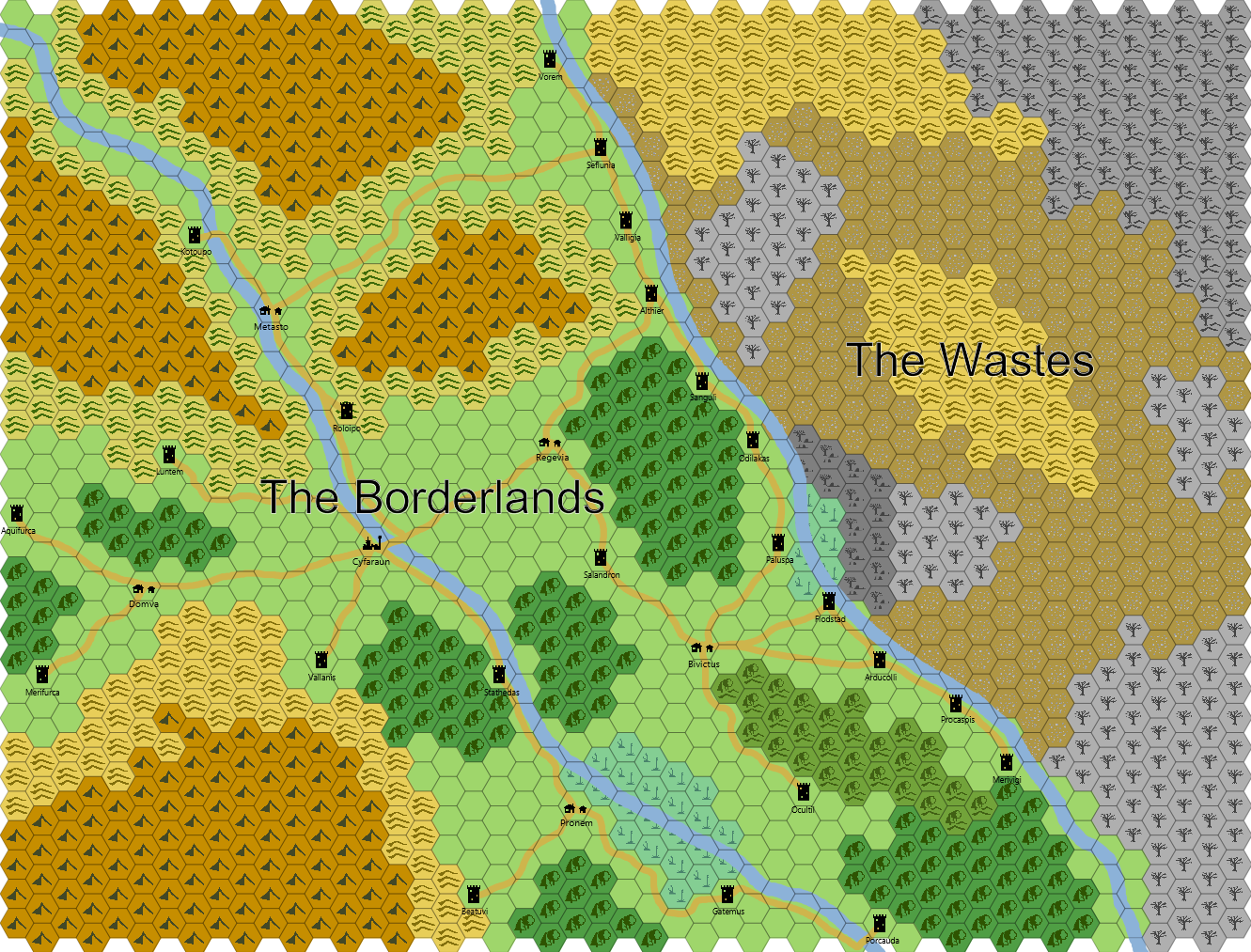
On the north-eastern edge of the Western Obrulion Empire, there is a pass between two mountain ranges. Parumisi to the North and Spondus Obrulus to the South. The Porta River runs North to South across this pass, naturally creating an incredibly defensible chokepoint. On this river sits the grand city of Cyfaraun, where the prince of the Borderlands watches over this far-flung corner of the empire. The Porta marks the beginning of the riverlands to its east, a great fertile basin that has been contested throughout history for its natural plenty. It’s lush forests and flood plains are littered with ancient fortresses, forgotten battlefields and the ruins of once great powers. Since the vile sorceress Isodor has risen to power, the riverlands have been poisoned by malice, overrun by beastmen and turned into a wild wasteland.
In the space between the Porta and the next river to the east, the Mortivena, a line of border forts keeps the proverbial hounds from the doors of the common folk. Seven years ago, many of the garrisons from the Borderlands were sent East, to vanquish Isodor, never to return. Now, the dangers facing the Borderlands are greater than ever. Beastmen and monsters are slipping across the weakened border to terrorize and plunder. Travel has grown perilous, and the border forts are becoming increasingly isolated and outmatched. Here at the edge of an already crumbling empire, the power structure of the region has begun decentralizing to local warlords and private armies. The strong survive, and the weak are crushed underfoot to become another relic, lost to memory.
The characters are all members of a mercenery guild who have taken up a lucrative job offer posted by one mysterious ‘Master Orius’:
SEEKING ABLE BODIED MEN AND WOMEN!
The Borderlands are being overrun by beastmen, and we don't stand a chance without knowing more about our enemy. The Guildmasters of the realm are under instruction to provide all those signing up with a list of rumored beastman redoubts and their approximate locations. Useful contacts will also be supplied for gathering further information. Clear these cursed locales and extract specimens, partial or whole. The Collector in Paluspa will purchase these for a fair price, live captives eliciting the highest bounty.

All signees should expect immediate contact by way of supplied provisions. Following this, further contact will be made upon proof of first success.

P.S. Learned men, scribes and ecologists shall also be rewarded for all salient findings.

- Master Orius
At the outset of session 1, the party have travelled together for a number of weeks since signing up to the job, gathering information and making their way to the first rumoured redoubt: The Vaults of Volokarnos. We begin in this dungeon, some 6 miles North of Althier, crossroad town in the northeast of The Borderlands…
Later parties may meet up with the first party in the Vaults, in the streets and domiciles of Althier, or somewhere else entirely. We shall see where the adventures lead.
Setting Overview
Millennia ago, the world was ruled over by an advanced solarpunk race who learnt to harness all the energy the planet provided. Seven thousand years ago, in a great act of hubris, they sought to go further and harness the power of the stars. A huge tower of incredible technological achievement was built at the highest peak and activated. The energy harnessed was so intense that it tore at the very fabric of the cosmos, and the spheres were dragged together in a great cataclysm the Elves know as The Night of Eternal Darkness. The cataclysm tore the world asunder, pulling beings from their spheres into ours. All lands were sent adrift in the vast oceans. These lands each took on some semblance of sentience, being inhabited or possessed by the spirits and deities from the other planes.
All was still for a time as the beings came to rest. Then, came the first shift. The beings awakened and shifted across the world, coming together in different combinations and orientations to form anew ecosystems. Where these beings come together, great rifts of untamed power form, ‘ley lines’, sometimes breaking free from the earth in places of power. Since the first shift, there have been three others, each sending the world into chaos as peoples are wiped out and civilizations forced to adapt and rebuild.
However, the lands have not shifted for some two thousand years. Since the last shift, the world has been comprised of one large continent and a scattered archipelago of smaller islands. The large continent, known as Kaelera, is the home of a myriad peoples, having been brought together by the fourth shift. Since the shift, Kaelera has seen many empires rise and fall. 325 years ago, the Obrulion Empire established itself as the dominant power on Kaelera. Ten years ago, a great chaotic sorceress known as Isodor discovered an ultimate source of power at the conjunction of the ley lines in the centre of Kaelera. Since then she has grown in power and the peoples of Kaelera have been forced to put aside their petty squabbles and unite against this common foe who would spread her malice across the world. With the most virtuous on campaign, presumed missing by many, the Obrulion Empire has turned on itself, her remaining rulers squabbling over the diminishing lands and people. The empire has fractured in two, while uprisings of oppressed minority groups continue to erupt and further disturb the status quo. Meanwhile, beastmen raids on the undermanned borders increase by the day.
Geography
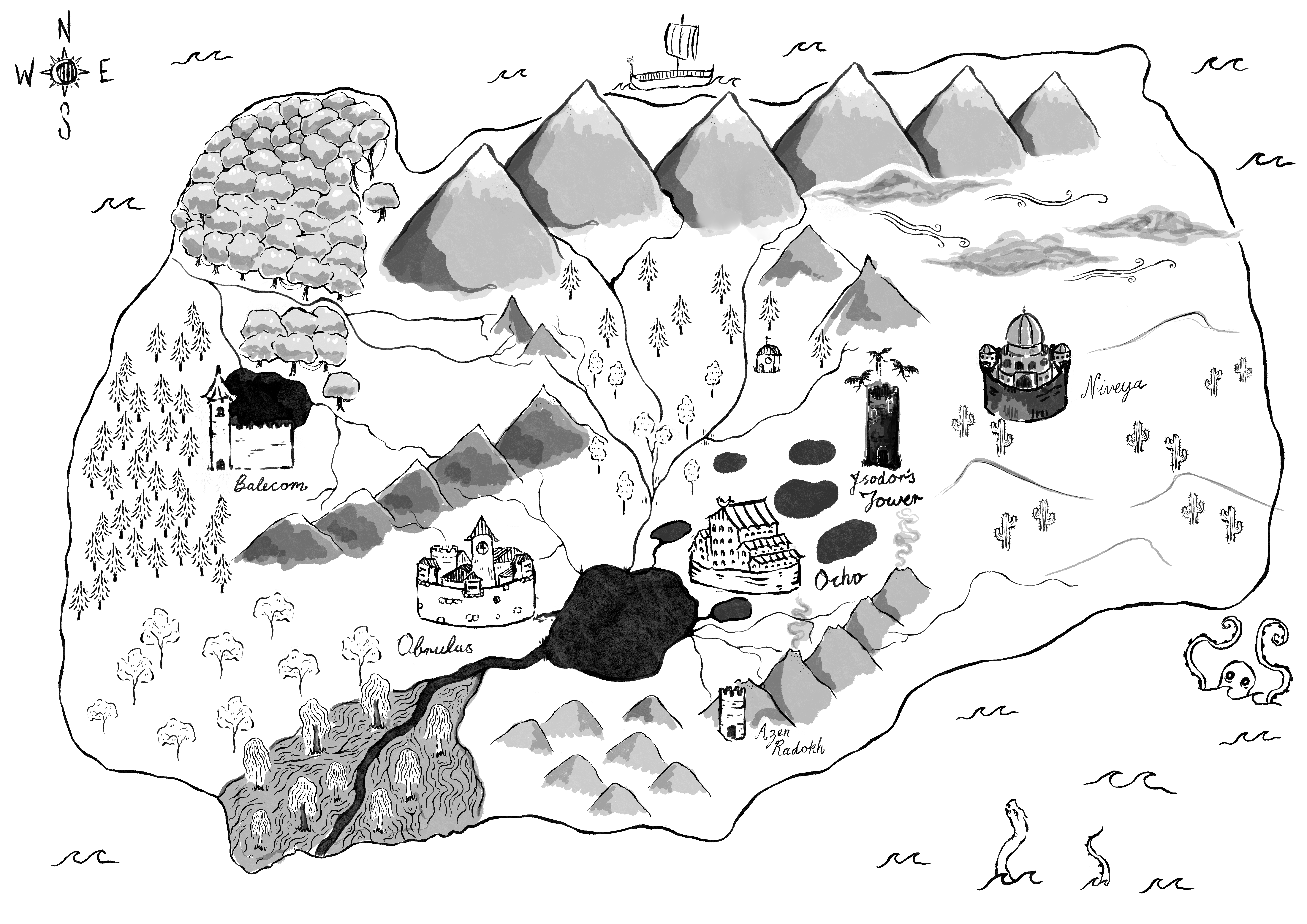
The continent of Kaelera is a landmass brought about by the collision of previously separate realms during the fourth shift. The North of the continent is dominated by a range of snow-capped mountains, known as The Oppland. From these peaks, petty Jarls watch over their icy domains. For the Opplanders, water is a way of life. From the northern shores, their fierce warriors set off on raiding vessels to pillage the coastal settlements of Kaelera, and of the isles beyond. In the colder months, the Opplanders were once known to plunder southward down through the riverlands, sometimes even breaching the Great Lake and striking at the heart of civilization. In more recent times, this seasonal way of life has been disrupted by the Obrulion Empire’s northern expansion and increased fortification throughout the riverlands.
A great plain spans the eastern side of Kaelera, from The Opplands down to the southern coast of the continent. The northern half of this plain is a tundra inhabited by the Lovasok people. Undoubtedly, the Lovasok are of Opplander stock originally, but they have traded the boat for the horse and unified under a single king. These are a stern, proud people and their raids into the deserts to the south are renowned for the hordes of horse archers coming up against the cameleers of the Caliphate.
The southern half of the great plain is characterised by wind-beaten deserts and shattered badlands, ruled over by the Mauvani Caliphate. The dessert is also the ancestral home of the nomadic Nenadan people. This is a land of juxtapositions. Some of the greatest minds spend their years pondering divinity and the arcane arts in their domed houses of knowledge. These holy places are situated within impenetrable walls in sprawling urban centres of the utmost grandeur and beauty. Just outside those same walls, however, the desert nomad struggles to survive in the parched land, robbed of his homeland and its natural treasures. Some Nenadan’s are lucky enough to join one of the renowned caravansaries of the Caliphate, others are forced into a life of banditry and depraved survival.
To the West of the plain, juts the volcanic mountain range known as the Gartnait Alps. This range has always been the ancestral home of the Dwarven people. Their vaults and mazes of catacombs perforate the earth here like swiss cheese. They are expert miners and crafts people, masters of rock and metalworking. In recent decades, their vaults have been overrun by beastmen and even fouler creatures of the deep. Only one vault remains, Azen Khador, standing strong against the onslaught, surrounded completely by those who would bring about the end of this proud race. The few dwarves that remain in other parts of Kaelera exist primarily as refugees mixing among the human populations of the world, cut off from their culture and way of life. Still, the fiery mountains of their homeland swell and belch on the horizon, and there isn’t a dwarf who doesn’t dream of retaking the ancestral vaults.
The Gartnait Alps spew rivers of lava down their western slopes and into the lake district below. Here, they combine with the many waterways to produce a fertile land for agriculture. The lake district spans from the Gartnait Alps, west to the Great Lake. Tributaries run from the riverlands in the North, the East and the West into this great cradle of civilization, with the water eventually exiting the Great Lake and surging down the Terminus River to the southwest where it meets the sea. The lake district is the domain of the Mizumi Dynasty. The people of these fertile, verdant lands rely on a primarily rice-based diet and foster great developments in agriculture, the arts and textile industries. The Mizumi are also known for their warrior culture, governed by strict codes. Even their religious officials are trained in the art of war. The capital of the Dynasty, Ocho, sits on the eastern edge of the Great Lake. If one were to cross to the western shore from here, one would find the shining city of Obrulus, heart of the Obrulion Empire.
The Obrulion Empire claims all lands south of the elven jungles, from the western shore of Kaelera, to the Great Lake and Terminus River. The vast forests of the west and swamplands of the south-west are all within its domain. The Spondus Obrulus (‘Spine of Obrulus’) runs south-west to north-east and bisects the empire into two. The empire formed as a hegemony that subdued countless native tribes with sword and sermon, allowing it to become the ultimate power on Kaelera. In recent years, the lack of strong leadership in the empire and the breaking down of effective communication has caused it to fracture into an eastern and western empire. The western empire is ruled from the seat of Balecom, on the southern border of the elven jungles, and spans the north-western side of Spondus Obrulus. The eastern empire is ruled from the traditional capital of Obrulus on The Great Lake, where peace and good trade has always prevailed with the Mizumi Dynasty.
To the north of The Obrulion Empire are the elven jungles. These untamed lands are cut off from the realms of men by many waterways, and from the Opplands by a small mountain range known in the Obrulion Empire as Parumisi (‘The Little Mercy’). The elves are an ancient, long-lived race, claiming to have witnessed the emergence of all other peoples. They are reclusive, and much of their ways are known only through rumours and hearsay. Being as far away as possible from the collision of all the other cultures, they keep to themselves and only occasionally will an Elf come forth from the jungles to intervene in the goings on of other folk. It is said that they possess innate magical abilities and live in tree-house communes where they frolic unclothed and unbothered through the trees. Anyone who has ever had the pleasure of being invited to the jungles, however, would tell you how their civilization is far more advanced than any empire of man.
Timeline
| Year | Events |
|---|---|
| <7000 BS | The world was ruled by a technologically advanced solarpunk race. Elves exist in a minority. |
| 7000 BS | The ancient rulers sought to harness the power of the stars, causing ‘The Night of Eternal Darkness’ and the first shift. |
| 6999 - 6000 BS | The world is quiet as new races appear and find their place. |
| 5999 - 5000 BS | Second shift - the world’s landmasses shift again, arranging themselves differently. |
| 4999 - 4000 BS | The elves build a great civilization spanning most of the world’s lands. |
| 3999 - 3000 BS | Third shift. |
| 2999 - 2000 BS | Civilizations rebuild. |
| 1999 - 1 BS | Fourth shift - formation of current continents including Kaelera. |
| 0 BS - 0 IY | Civilizations rebuild. |
| 1 IY | The Obrulion Empire establishes itself as the dominant power on Kaelera. |
| 315 IY | The chaotic sorceress Isodor begins to spread chaos from her seat of power. |
| 318 IY | The peoples of Kaelera unite against Isodor, sending their finest legions to the source. |
| 320 IY | The Obrulion Empire fractures into western and eastern empires. |
| 325 IY | The current year… |
BS – Before shift. These dates are counted backwards from the year of the fourth shift. Like the real world’s BC/BCE.
IY – Imperial year. These dates are counted forwards from the year that the Obrulion Empire established dominance of Kaelera. Like the real world’s AD/CE.
Customs
Laws and Governance
The Obrulion Empire was once a single entity. In 320 IY, the empire fractured into an eastern and western empire. The loss of its best legions and leaders against Isodor and the growing pressures from within ultimately caused this divide. The Eastern Obrulion Empire maintains rule of the Eastern side of Spundus Obrulus, down to the swamps in the southwest and up to the top of Spundus Obrulus in the northeast. The Eastern Emperor still rules from the traditional seat of Obrulus. The Western Obrulion Empire claims all lands West of The Spine, as well as the Borderlands. The Western Emperor rules from Balecom, on the southern edge of the elven jungles.
The cultures of the eastern and western empires are distinct, with the former being more heavily influenced by its long-standing relations with the Mizumi Dynasty, while the latter draws much more influence from the native peoples that once ruled over the swamps and forests of the West. Both are hegemonic in governance structure and share most laws. The Emperors are all powerful but do not have the resources to manage such vast domains, and a complex system of vassalage and tribute exists to divide the empires into smaller and smaller domains. With play beginning in a province within the Western Obrulion Empire, the Borderlands, the focus of this document going forward will be on the cultural aspects of the Western Obrulion Empire, with contrasts drawn between itself and the Eastern Empire when useful.
Coins and Money
The two Empires have not had sufficient time since their separation to establish their own coinage, and the old currency still dominates trade. The common coin is the copper mark. 10 copper marks make 1 silver crown, and 10 silver crowns are worth 1 gold sun. Each coin weighs approximately 5g.
Older civilizations sometimes used platinum and electrum pieces, worth around 5 gold suns and 5 silver crowns respectively. These can be found in treasure hordes throughout Kaelera and are viewed with some suspicion by merchants in the Empires.
Fashion and Dress
The Western Obrulion Empire experiences cooler temperatures relative to the Eastern Empire. In contrast to the loose, flowing and often revealing fashions of the East, the people of the Western Empire tend to wear more layers and warmer fabrics. Despite these differences, many of the ideals around fashion are shared. High value is still placed on beauty of the face and body, though the women and men of the West must get a bit more creative to show off these features. Shows of status are very important for both sexes: fine fabrics, rare colours and flashy accessories are all ways of showing status and wealth. The fashions borrowed from the Eastern Empire are impractical for the working commoner living in the Western climate. For this reason, the loose, flowing style is extremely popular among the upper classes of the West who use it to show they are above the practical restrictions of the working commoner.
Common women wear simple, homespun dresses that may or may not have sleeves depending on the time of year. These are often accompanied by a cloth belt and low hide boots. Their hair is traditionally worn long but tied back in simple buns or braids. Aristocratic women wear elaborately decorated garments. They prefer gaudy coloured dresses of the finest materials, often accompanied by tight girdles of ornamental leather or metal and soft leather boots. Piercings of the ear are common, as are anklets, armlets, bracelets, chokers, circlets, necklaces, rings and tiaras. Upper class women wear their hair long and elaborately coiffed.
Men typically wear knee-length tunics, which may or may not be sleeved depending on the time of year. The lower portion of the tunic is generally split for mobility. In formal circumstances, men add luxurious long-sleeved robes over the tunic, but for travel, semicircular or oblong cloaks are preferred. In the field, military cloaks are often worn pinned on one shoulder for ease of movement and access to a weapon.
High leather boots are popular among noble men, where commoners wear low leather or even hide boots. Leggings are worn under the tunic in all but the hottest months. Sashes with buckles are common and usually very ornamental. Men’s hair is typically kept short and neat, with faces kept clean shaven or with neatly groomed facial hair. Armlets, rings and brooches are common for noble men.
For both sexes, favoured colours include whites, reds, dull blues and various shades of beige and brown. Along with jewel tones of ruby-red, topaz-yellow, amethyst-purple, emerald-green, and sapphire-blue. Grey is considered the colour of death and worn only during mourning.
Slavery and Indenture
Slavery, as is practiced in the more ‘barbaric’ lands of Kaelera, does not legally exist within the Obrulion Empires. However, foreign nobles mock the Obrulion pretension that “there is no slavery in the Empires,” because lifelong indentured servitude is widespread and fulfills a similar economic and cultural role.
Indenturing is the process of selling oneself into servitude. At any time, any man or woman may sell themselves into indenture. Indenture is generally for 1 year, 7 years, or 21 years, though in principle any term may be devised. Lifelong indenture is imposed by the state on violent criminals, with eternal indenture (which gives the master and his heirs the right to the servant’s services even after death) reserved for heretics and traitors.
Taxation
Empires are maintained with iron and gold – iron to wage war and gold to fund it. To assure that the Empire is never short of gold, the imperial officers who govern its various domains are expected to collect fees upon marriage, inheritance, birth and death, harvest, and other occasions; to levy fines and fees for administering justice; to charge tolls for the roads; to charge duties on merchants in their markets; and to extract (directly or via forced labor) grain, ore, and timber from those working their land. From these funds, the ruler is obligated to send a tributary payment to his superiors. The remainder is expected to be used to maintain a garrison and stronghold in the domain; to support the local temples; and to pay for the ceremonial games, sporting events, religious feasts, country festivals, and other public works that demonstrate the greatness of Obrulion civilization.
Jurists are often called upon to decide the rightful owner of treasure recovered by exploration and warfare. Ancient law holds that half of all treasure lawfully recovered inside the Empire belongs to those who recovered it, while the other half belongs to those who own the land upon which it was found – either the private owner or the Empire itself. Often, however, local rulers will waive these taxes, or at least look the other way, if adventurers protecting their lands from monsters recover some treasure from their victories. Treasure lawfully recovered outside the Empire, of course, belongs entirely to those who recovered it. Treasure unlawfully taken from the Empire or its peoples is not (legally) treasure at all, but stolen goods!
Travel and Vehicles
The Empires’ paved roads, built over centuries of expansion, are said to be over five thousand miles in total length. The Imperial Cartography Service maintains extensive maps of the countryside, roadways, and even street maps; much of the Empires are correspondingly easy to get around.
Travel along the roads is commonly by foot or horse. Wealthier citizens may also travel by servant-borne litter or by chariot or covered carriage. Merchants generally rely on large, four- or six wheeled wagons drawn by teams of horses or oxen. On the sea-lanes, most merchant vessels are square-rigged sailing ships, while warships are generally galleys with multiple sets of oars for increased maneuverability and speed.
Engineering and Construction
In architecture, both Empires build with stone, brick, wood, cement and concrete. Noteworthy are the many great amphitheaters and colosseums found in the major cities. Wonders of Obrulion acoustic engineering, each can seat tens of thousands, yet can project a performer’s voice from the centre of the stage to the farthest back row.
Perhaps most of all, the Empires are known for their marvelous aqueducts, dams, and bridges, which control and traverse the many waterways. Sewers of mind-numbing complexity run under the great cities, connecting with the aqueducts and canals. Water wheels and windmills turn fluid movement into power, and hydraulic pumps and siphons transform power into movement. Because of these sophisticated waterworks, the citizens enjoy public baths with warm, hot, and cold water as well as bronze indoor plumbing with flush toilets.
Religion and Myth
The Obrulion Empires acknowledge the existence of two pantheons of powerful deities, the Luxian and the Chthonic. In general, the Luxian powers are associated with law, light, and creation, while the Chthonic powers are associated with chaos, darkness, and destruction. The Luxian gods are revered and worshipped while the Chthonic powers are feared and reviled.
The Luxian faiths teach that after death, the body must be burned so that the soul can be swiftly ushered to the afterlife, where its valour is weighed. Base and sordid souls drink of the waters of sorrow and return to the realms of man in a new body. Noble, heroic souls pass to the Luxian Heaven, to dwell in the glory of the halls of Luxeus. The Exalted (as they are called) are venerated by their descendants and often asked to intercede with the gods on their behalf, and Exalted emperors and heroes may be widely worshipped as demi-gods.
The Chthonic faithful do not believe in this cycle of life, death and rebirth. They believe that upon death, the soul is consumed and used as fuel in the creation of new life. They see reincarnation of the soul the same way one sees fungus growing in a corpse — new life, yes, but not the same life. They see, not a choice between paradisiac afterlife and worldly reincarnation, but between undeath and oblivion. They thus seek to keep their souls and their bodies intact lest their singular identity be destroyed by the cycle of death before the time of the Awakening. The Awakening is a prophesized future when the Chthonic gods shall return to the earth and the faithful shall enjoy a true bodily resurrection. The day of this Awakening is unknown. Some sects claim it can be known by the movements of the stars, others only by the will of the gods.
The head of the Luxian pantheon is known as ‘Luxeus’, though he has different names and epithets in the Western and Eastern empires. In the Western Empire, he is known as ‘Luxeus Dynamicus’, while in the East as ‘Luxeus Staticus’. Following is an incomplete list of gods and their aspects, with more to reveal themselves during play.
Luxeus Dynamicus: Offers truth, preservation, peace, light and renewal through graceful adaptation to change and continual learning. Luxeus Dynamicus is the primary god of The Western Obrulion Empire and is also the patron god of travelers and pilgrims. His symbol is that of a sun behind a stick or walking cane. There is a popular branch of this church that worship an elven martyr directly, he having traveled south from the jungles, bringing truth and teachings to the world of men.
Luxeus Staticus: Offers truth, preservation, peace, light and stability through adhering to tradition and the order established by lawful civilization. Luxeus Staticus is the primary god of The Eastern Obrulion Empire and the patron god of rulers, bankers and stonemasons. His symbol is that of a sun behind a stout stone tower.
Leviathea: Goddess of The Great Lake and all watercourses connected to it. She presides over freshwater, horses, nature’s bounty and the human desire to be idle. Her symbol is a set of scales with water drops on either side. Leviathea’s crusaders are known for their horse companions and unique heavy weapon fighting style.
Krakiva: Goddess of civilization, the oceans, storms and agriculture. She is the patron god of sailors and farmers and the twin sister of Leviathea. Her symbol is a many armed woman, each hand holding a different tool associated with civilization (gavel, scales, hoe etc).
Ianna: Goddess of war. A lesser-known goddess worshipped primarily by the female-exclusive sect of Bladedancers hailing from a remote temple within Opplander territory. Her symbol is a seven pointed star.
Hypnos: God of sleep, recuperation, distraction and hedonism. The son of Leviathea, his followers believe that regular, deep sleep is the path to health and enlightenment. If a bit of chemical aid is needed to get there, so be it.
Peoples
Equivalents
Some of the classes in the ACKS II Revised Rulebook allow the player to select a class variant based on region, Barbarians and Witches being notable examples. The peoples of my setting can all be represented by the region choices in the rulebook. I’ve listed these details below, alongside the real world cultures that they draw from.
| Setting Culture | Rulebook Region | Real-world Equivalent |
|---|---|---|
| Tirenean | Auran Empire | Western Roman |
| Nicean | Auran Empire | Eastern Roman (Greco-Roman/Byzantine) |
| Krysean | Auran Empire | Continental Celtic (Gaulic/Early French, Italian, Spanish) |
| Rornish | Rorn | Insular Celtic (Welsh, Cornish, Britton, Pictish) |
| Mizumi | - | Japanese/Chinese |
| Opplander | Jutland | Northern Germanic/Viking |
| Lovasok | Skysos | Kievan Rus |
| Mauvani | Opelenea | Persian/North-African/Islamic World |
| Nenadan | Ivory Kingdoms | Sub-Saharan African nomads |
| Dwarven | Meniri Mountains | Bit of Tolkien, bit of Warhammer |
| Elven | Northern Argölle | Tolkien Elves but more fae with a pinch of Celtic culture |
The various peoples are detailed below.
Tirenean
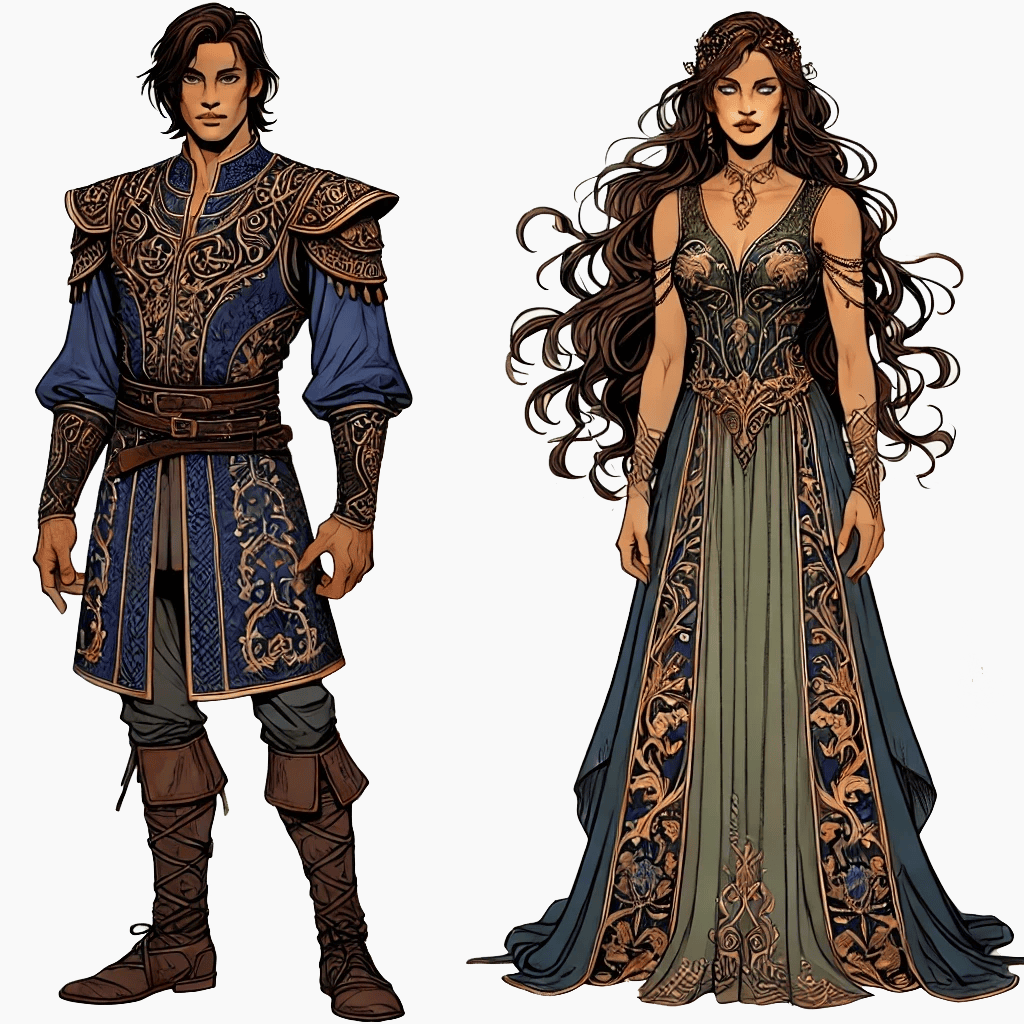
The empire-building Tireneans hail from the western shores of The Great Lake. They can be found throughout Kaelera, though their greatest concentration remains in the Eastern and Western Obrulion Empires.
Tireneans are tall-statured (men averaging 5’9”) with athletic body builds characterized by broad shoulders and narrow waists. They have long oval-shaped faces with upright foreheads, prominent cheekbones, narrow jaws, and moderately full lips. Tirenean eyes are deep-set and round, with coloration varying between blue-grey, grey, grey-brown, light brown, and dark brown. Their skin color is light but tans to dark brown. Tirenean hair is straight or wavy, and colored dark blonde, ash brown, dark brown, or black. The men have moderate beard and body hair.
Tireneans are proudly traditional about names, and take care to give every child a carefully-chosen Classical Obrulion name (although as fluency with Classical’s complexities has slipped away, many provincial Tireneans now carry vulgarized or hybridized versions of the old names). Moreover, while elsewhere in Kaelera only the upper classes have surnames, in Tirenea even commoners possess hereditary family names (e.g. “Syrena Drakon”). Classically, it has often claimed that every Tirenean was descended from nobility, which may account for Tirenea’s name itself - “land of crowns”. Perhaps because commoners have two names, nobles often claim a third name or cognomen based on some characteristic or accomplishment (e.g. “Audarius Valerian Tarkaun”).
Male Names: Obrëus, Celictor, Destrio, Gundus, Omus, Quellus, Tavus, Valen, Zelicus
Female Names: Obrëlyn, Celena, Dalefa, Hyapsë, Istria, Nauriva, Riara, Syrena, Valanna, Zeodarë
Surnames: Amadorus, Drakon, Hyatavië, Ionicus, Mennicus, Nuvicerres, Süromus, Tarcalus, Valerian
Nicean
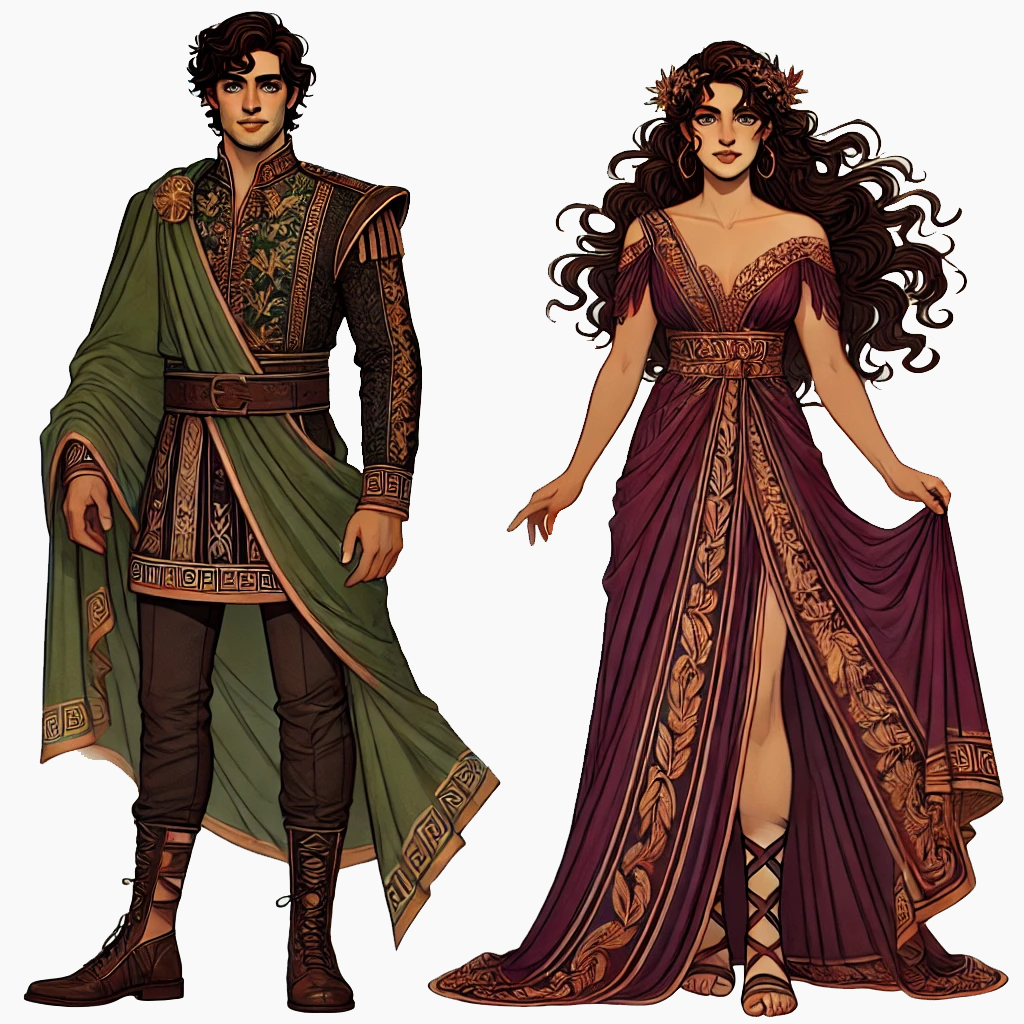
The people of Nicea have a long history as custodians of the Terminus River and the warm south-western marshes of Kaelera. They consider themselves one of the greatest maritime peoples of the continent. Much of the Obrulion Navy is staffed by Niceans, and their superbly crafted river boats ply the waterways of the continent, bearing some of the most trusted merchants. Today, Niceans can be found in every coastal city and settlement of the Empire, as well as in their own muggy homelands. Much of Nicean culture has found its way into the high society of the Eastern and Western Obrulion Empires. Some even refer to the capital, Obrulus, as ‘New Nicea’. Just not in front of a Tirenean.
Niceans are medium-statured (men averaging 5’8”), with athletic to stocky body builds characterized by compact bodies and sturdy limbs. They have oval-shaped faces with wide, slightly sloped foreheads and moderately full lips. Nicean eyes are deep-set and round, with green, hazel, brown, and dark brown color. Their skin color ranges from light to medium brown, but tans to dark brown. Nicean hair is straight, wavy, or curly, and colored dark blonde, ash brown, dark brown, or black. Their eyebrows tend to be thick and darker than their scalp hair. The men have heavy beard and body hair.
Niceans typically carry a given name in Classical Nicean, often referencing a grandparent, great uncle, or great aunt. In lieu of hereditary family names, they use patronyms formed by adding the suffix -adis, -akis, -atos, -ides, or -poulos to the father’s name (e.g. Metoros, the son of Vason, might be “Metoros Vasonides”). If a Nicean moves to another place he may replace his patronym with his village, town, or city of origin (e.g. if Metoros Vasonides is from Valligia but living in Obrulus, he might be called “Metoros Valligia”). Prominent nobles, philosophers, heroes, and other persons of distinction may carry a sobriquet before or after their given name (e.g. if Metoros is a smooth talker, he might be “Metoros Golden-Tongued). Niceans who are citizens of the Empire may take an Obrulion name or Obrulionise their existing one.
Male Names: Apollonis, Basilio, Damanos, Iannis, Klenos, Metoros, Peristo, Spyros, Thales, Vason
Female Names: Acandra, Bassida, Daphyra, Eliona, Iandra, Neoma, Olyma, Selene, Thena, Zene
Krysean
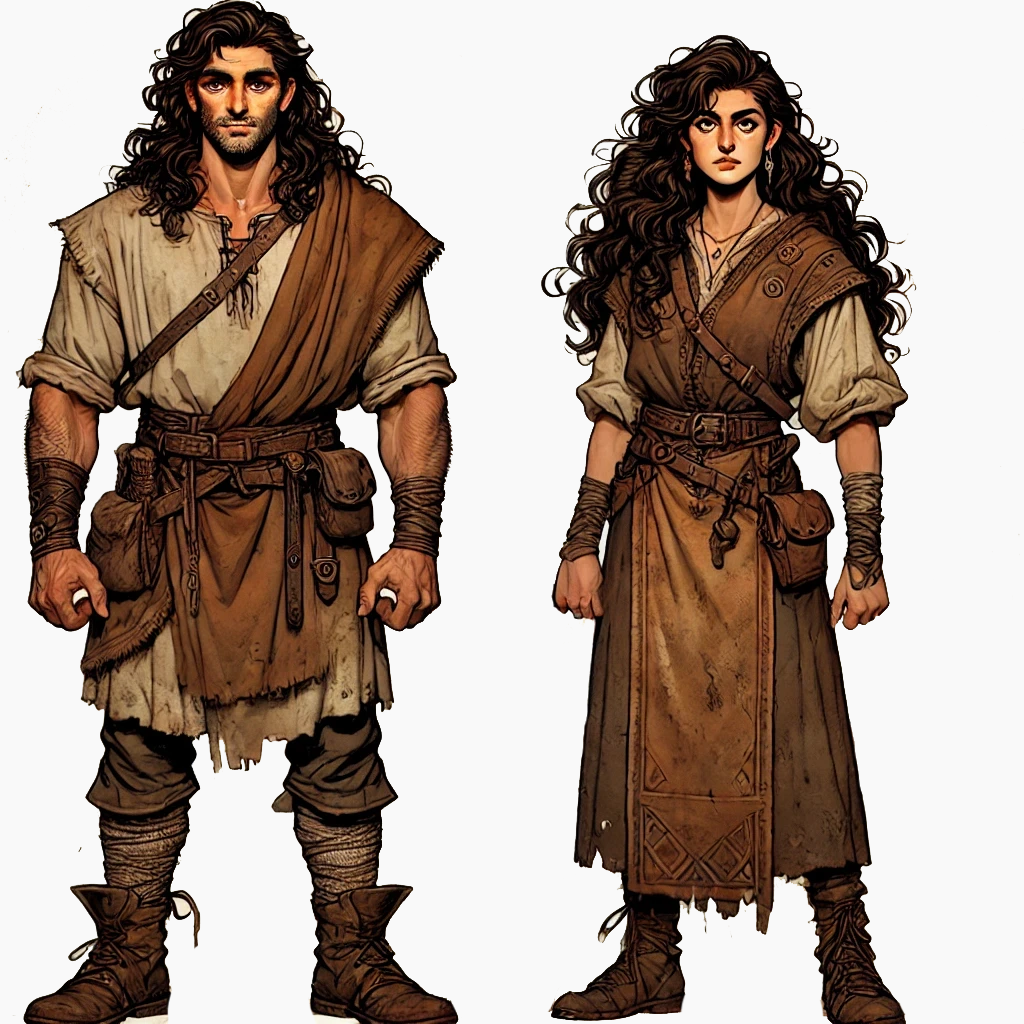
The stout and stoic Krysean people originally hailed from the rugged mountain range now known as Spundus Obrulus, which divides the Obrulion Empire into an East and a West. For over five hundred years their fate has been intertwined with that of the Obrulion Empire. Today, Kryseans can be found anywhere the Empire is or has been, working as craftsmen, laborers, merchants, and soldiers.
Kryseans are medium-statured (men averaging 5’8”), with athletic to stocky body builds characterized by compact bodies and short, sturdy limbs. They have oval-shaped faces with wide, slightly sloped foreheads and moderately full lips. Kryseans eyes are deep-set and round, with hazel, brown, and dark brown color. Their skin color ranges from light to medium brown, but tans to dark brown. Krysean hair is straight, wavy, or curly, and colored rufous brown, auburn, dark auburn, or brown-black. Their eyebrows tend to be thick and darker than their scalp hair. The men have heavy beard and body hair.
Kryseans are generally named in Classical Krysean after a favored ancestor, a mythic hero, or a close relative. Kryseans do not carry hereditary family names, instead indicating paternity simply by appending their father’s name after their own (e.g. Mandonio, the son of Terkinos, would be “Mandonio Terkinos”). Kryseans who have left their homes may use a toponymic, formed by adding -tar or -atar to the name of their village, town, or city of origin (e.g. Nesca from Kavala may call herself “Nesca Kavalatar”). Kryseans who are citizens of the Empires may take an Obrulion name, or may Obrulionise their existing one.
Male Names: Aibekeres, Bodilkas, Culchas, Hilerno, Indikortes, Mandonio, Pirreso, Sigilo, Terkinos, Uxentio
Female Names: Ausa, Chiomara, Daleninar, Ederata, Isbatara, Kara, Megara, Nesca, Sicounin, Unia
Rornish
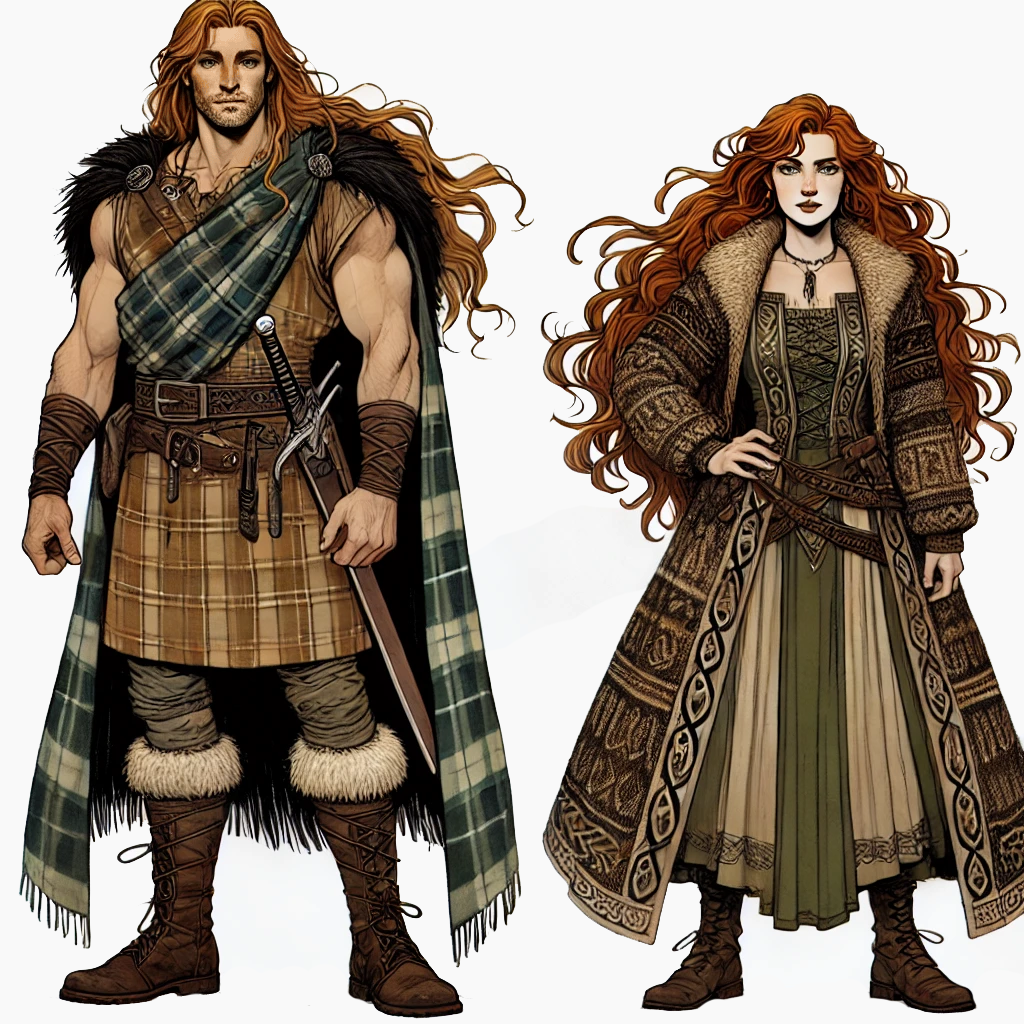
Once as barbaric as the Opplanders, the Rornish people were gradually subjugated and civilized by the Obrulion Empire as it expanded West across Spundus Obrulus into the forrests and islands of their homeland. Rornish folk can be found throughout the provinces of the Western and Eastern Obrulion Empires as craftsmen, soldiers, and servants. Rornish society is traditionally matriarchal, unique in this way among the realms of Kaelera. Rornish women tend to be stronger, both physically and in force of character, than other women of the Empires. This behaviour is seen as ungainly by many who do not understand their ways. Recently, many Rornish clans have been gathering in unsupervised parts of the Western Empire and rebelling in an attempt to reclaim their culture and lands. As the public opinion of the Rornish sours throughout the Western Empire, these people can find themselves facing racially motivated antagonism and unfair detainments.
Rornish people are tall-statured (men averaging 5’10”) and athletically built, with broad shoulders and narrow waists. They have oval- or triangle-shaped faces with broad foreheads, narrow jaws, and moderately thin lips. Rornish eyes are round and deep-set, with coloration of blue, blue-grey, green-grey, green, hazel, or light brown. Their skin color ranges from fair and freckled to light brown. Rornish hair is straight or wavy, and colored golden blonde, strawberry, red, golden brown, rufous brown, auburn, or dark auburn. Their eyebrows tend to be thin and paler than their scalp hair. The men have moderate beard and body hair.
Rornish folk are typically named in the Ivorean language for a famous hero, ancestor, or relative. Rornish commoners do not carry hereditary family names. Men and women indicate maternity simply by appending their mother’s name after their own (e.g. Owain, son of Ceridwen, would be “Owain Ceridwen”). However, Rornish nobles do carry hereditary family names; these are indicated by the identifier Ty followed by the name of their noble house (e.g. Urien, of House Caradoc, would be “Urien Ty Caradoc”). Because Rorn has been a province of the Obrulion Empire for centuries, many Rornish people carry Obrulion or Obrulionised names (e.g. “Urienus Caradocian”), especially in the big cities, where the Obrulion influence is most strongly felt.
Male Names: Aeron, Braig, Caradoc, Georn, Mard, Owain, Roben, Stuarry, Theon, Urien
Female Names: Anwen, Ceridwen, Deiresa, Eirwen, Katrist, Maranie, Nimue, Rachess, Seren, Vale
Mizumi
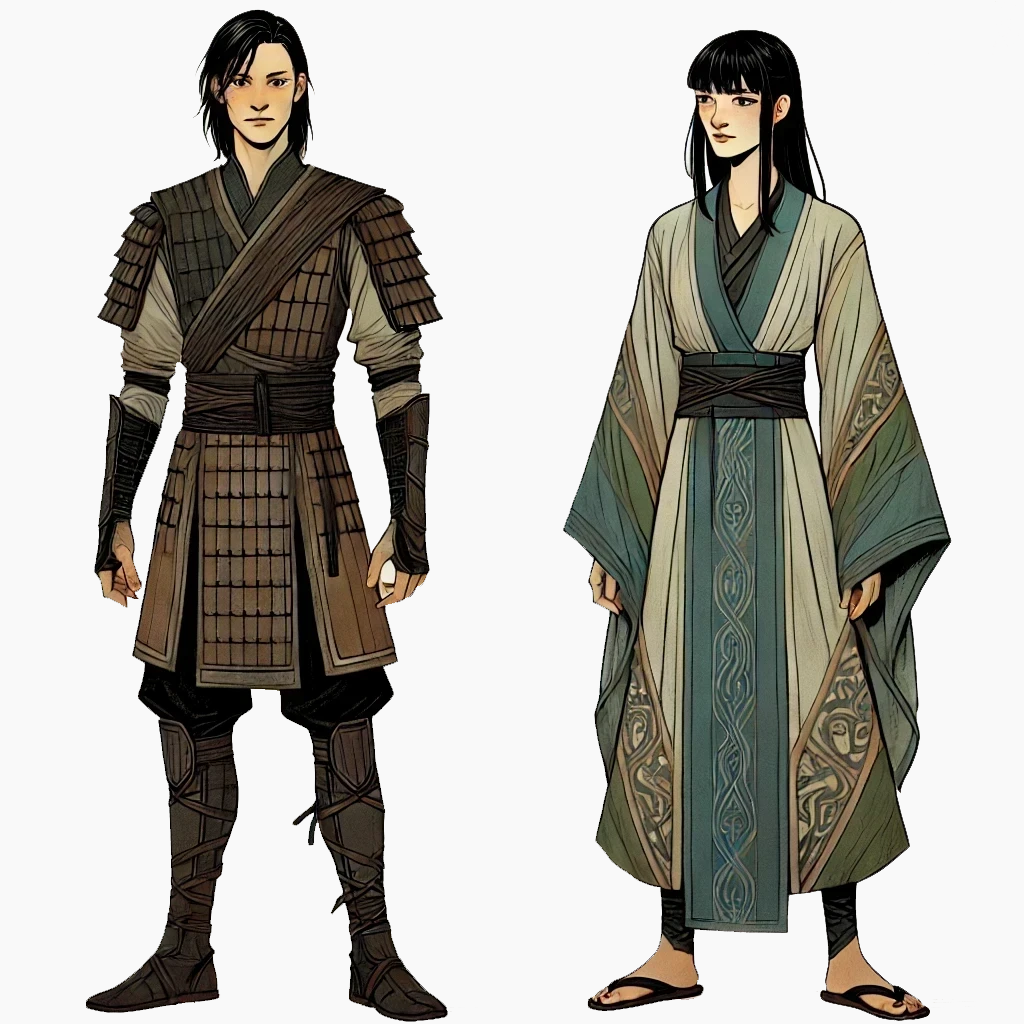
The Mizumi have always existed throughout the verdant lake district. Their royal family is able to trace its lineage through an unbroken chain, all the way to the first Emperor that united the lake clans. The royal family are only figureheads who provide legitamacy to the many Daimyo, who hold the real power. These military rulers are family heads of the proud lake clans who are constantly fighting between themselves over age old blood feuds and territorial disputes. Their warriors and warrior-monks who could go toe to toe with any Bladedancer are sought continent wide as elite mercenaries. Somehow, in spite of this chaos and military environment, the Mizumi still consider themselves a united people. They have made some of the finest developments in arts and the agricultural sciences in Kaelera.
Mizumi people are short-statured (men averaging 5’6”) and of slim build, with narrow shoulders and waists. They have round or oval faces with soft jawlines and moderately thin lips. Mizumi eyes tend to be thin and ‘single eyelidded’, with dark colourations being common. Their skin color ranges from fair to tan. Mizumi hair is straight and black. Their eyebrows tend to be thinner than their scalp hair. The men have minimal beard and almost no body hair.
Mizumi people are named in the Mizumi tongue for the boon their parents hope they will provide to their clan, or the bane they will inflict on enemy clans. In this way, names tend to be gender neutral. For example, a child born to an impoverished family may be named ‘Tomi’ (meaning ‘wealth’). A child born into a clan with a long standing unresolved blood feud with another clan might be named ‘Gyakusatsu’ (meaning ‘massacre’ or ‘carnage’). Commoners do not carry family names, but noble Mizumi simply prepend their clan name. For example, Tomi of the twin river clan would be named ‘Futatsukawa Tomi’. Sometimes, great warriors or heroes of the people will be awarded the privilege of carrying the clan name by their Daimyo.
Male/Female Names: Shiawase, Kodomotachi, Shukaku, Hokori, Massho, Shi, Fumeiyo.
Clan Names: Higashimizu, Oka, Ryuiki, Midorihato, Tanbo.
Opplander
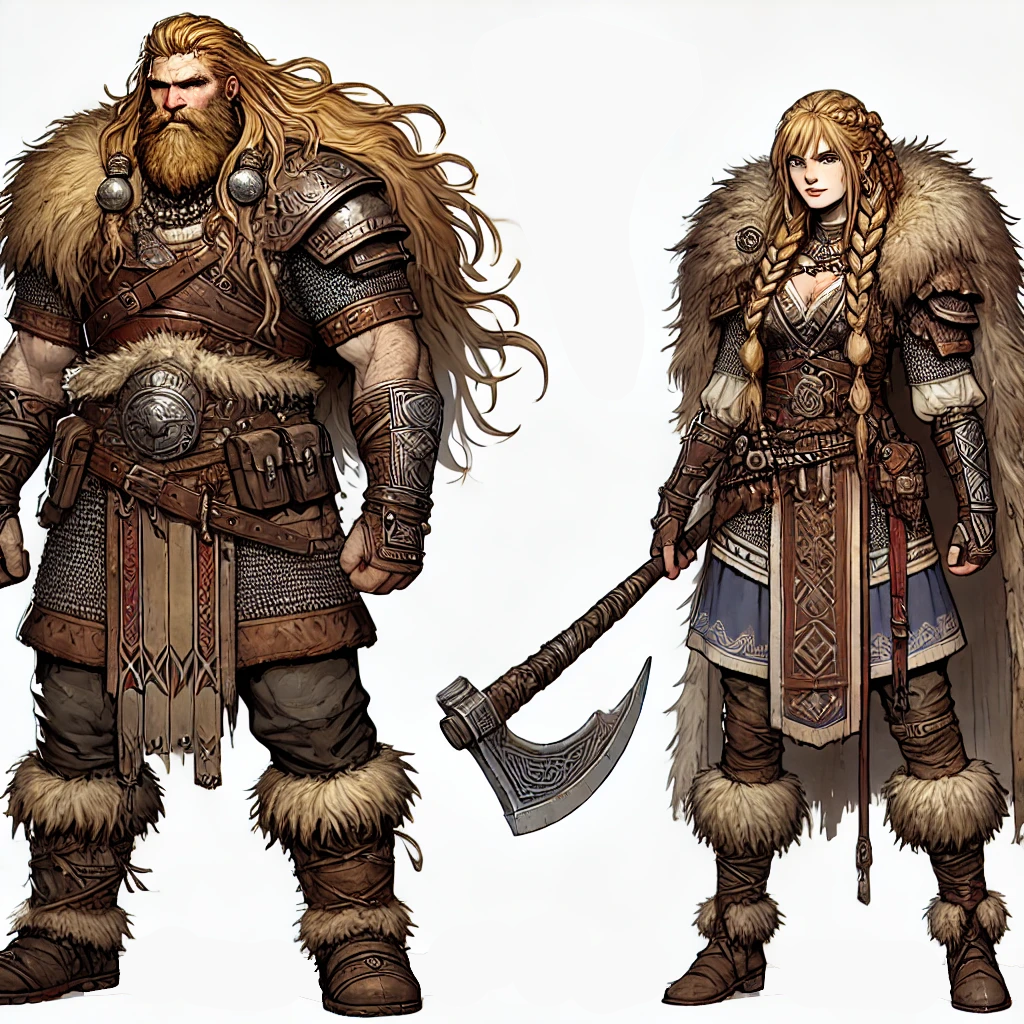
Since time immemorial, barbarian tribes have dwelled along the frigid North coast of Kaelera and among the snow-capped peaks there known as the Oppland. These Opplanders arrange themselves into loosely allied groups, each claiming dominion over one or more mountain peaks and a section of coastline. The tribes respect these ancestral boundaries and general peace is had between them. When out raiding, the Opplanders are goverened by an entirely different code. While tribes have been known to collaborate on the ocean and river raids the Opplanders are famous for, usually it is more of a sport to see which tribes can make the most kills and take the most loot. Killing warriors from other tribes is part of the competition, especially if Kaelera’s coastal towns have suffered a scarce winter or two.
Opplanders are tall-statured (men averaging 5’10”) with robust body builds characterized by thick necks, broad shoulders and hips, and large-boned limbs. They have wedge- or square-shaped faces with short, steep foreheads, heavy brow ridges, and broad, strong jaws. Civilized peoples find their facial features blunt and harsh. Their eyes are deep-set and colored either grey, light blue, blue, grey-blue, blue-green, or green. Jutlandic hair is straight or wavy, and colored golden blonde, dark blonde, golden brown, or rufous brown. In some of the higher altitudes of the Opplands, platinum blonde hair and eyes of violet or pale, colorless grey are seen. The Opplandic skin color ranges from pale to fair. The men have heavy beard and body hair.
Opplanders are typically named in Old Opplandic for a famous hero, ancestor, or relative. Instead of hereditary family names, Opplanders use patronyms formed by adding -sson or -dottir to the father’s name (e.g. Gunnar, son of Olf, would be “Gunnar Olfsson”). Chiefs, heroes, and other persons of distinction may take or be given sobriquets based on their appearance, personality, or deeds (e.g. if Gunnar wins renown for slaughtering many foes, he might be called “Gunnar the Bloody-Handed”).
Male Names: Asmund, Brardi, Dagr, Gunnar, Inthorn, Olf, Rannulfr, Sigwulf, Thorfin, Volundr
Female Names: Astrid, Brynhild, Dagny, Eira, Ingrid, Katla, Nessa, Signy, Thyra, Unnhild
Lovasok
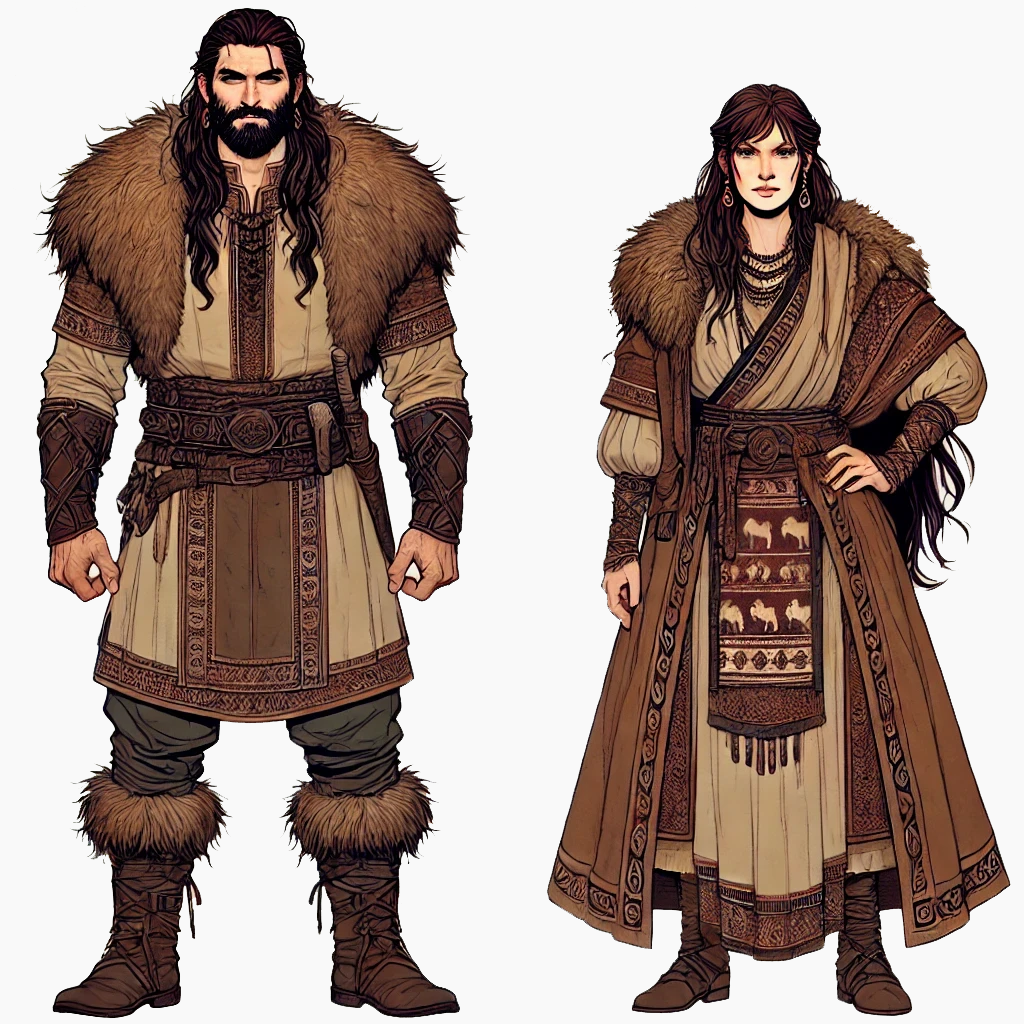
The Lovasok share genetic origins with the Opplanders, but their culture is entirely distinct. These people inhabit the vast tundra that spans East and South of the Opplands, all the way to the south-eastern desserts ruled over by the Caliphate. Once nomadic steppe people, Lovasok society still centres on their relationship with beasts. Horses are especially important to their culture, and a child is not considered beyond infancy until it can ride its first horse, usually an older Nag. Thereafter, the child is bonded to the beast for the remainder of its life and will refer to this horse forever as its ‘horse-mother’. The once separate tribes are now united under a single King, who maintains power through might and religion, exacting tribute from the local lords of the tundra. While the Lovasok are not seen to be as barbaric as the Opplanders by civilized Obrulion society, they having accepted the Luxian gods, these people are still more outsider than not. If nothing else, they serve as a useful buffer against the Obrulion Empires’ biggest threat, the Caliphate of the desserts.
The Lovasok are tall-statured (men averaging 5’10”) with robust builds similar to the Opplanders. They have square- or wedge-shaped faces with prominent brow ridges and strong, pointed jaws. Their eyes are deep-set and colours can range from greys and light blues all the way to dark greens and browns. Lovasok hair is straight and all shades of brown can be found, with the occasional fair or truly dark haired individual being a sign of inter-breeding with the Opplanders to the North or Mauvani to the South respectively. Lovasok skin colour is fair to tan. The men have heavy beard and body hair.
The Lovasok are named after religious characters (e.g. sanctified holy men and women) or ancestors. All Lovasok also carry their horse-mother’s name while bonded. At the death of their horse-mother, a coming of age ceremony is held, and the Lovasok will have their horse-mother’s name replaced with their clan name. This is considered the age of maturity for a Lovasok adolescent. The famous mounted warriors of the Lovasok are all beyond the age of maturity, having earned the right to call their mounts their brothers and sisters.
Male Names: Ivan, Yakub, Borys, Dymitri, Sergeij, Vasyl
Female Names: Anastasia, Olga, Mariya, Kateryna, Tetiana
Mauvani
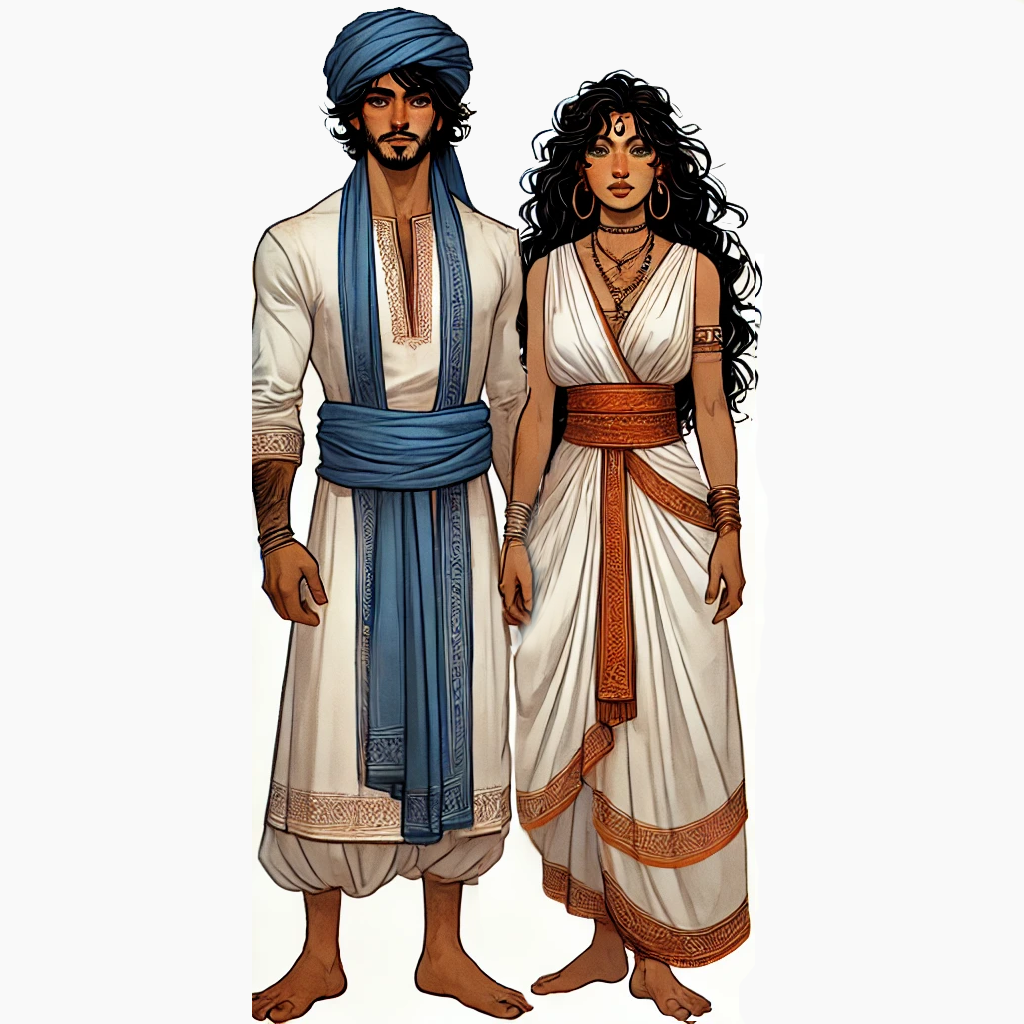
The Mauvani Caliphate is the second most powerful civilized faction on Kaeler, having carved great domed cities out of the barren south-eastern desserts and badlands. Renowned for their mercantilism and learned men and women, caravans from the Caliphate can be found throughout Kaeler, their merchants striking shrewd deals atop towering camels and elephants. The dyes, incenses and spices of the Caliphate are of particular renown and in great demand throughout noble courts of the Obrulion Empires. Mauvani society is caste based, and as their civilization is restricted to relatively few bustling urban centers, the merchant lords of the desserts each operate relatively independantly as city-states. Of course, these lords still are absolutely loyal to their religious head, the Grand Caliph.
Mauvani are medium-statured (men averaging 5’7”) with lean builds. They have oval- or ellipse-shaped faces with moderately sloped foreheads and full lips. Mauvani eyes are large and almond-shaped, with hazel, brown, or dark brown color. Their skin color ranges from medium to dark brown. Mauvani hair is wavy or curly, and colored dark brown or black, with ash brown or dark blonde occasionally seen. Their eyebrows tend to be thick and darker than their scalp hair. The men have heavy beard and body hair. Years of the slave trade have given many Mauvani traces of foreign blood, so features common in other peoples are not all too uncommon.
Mauvani are traditionally given names in Old Mauvani, typically taking a grandparent’s, great uncle’s, or great aunt’s name. They do not use family names, instead indicating lineage by attaching the patronymic Bar (“son of ”) or Bat (“daughter of ”) to their father’s name (e.g. “Danel Bar Uthman” is “Danel, son of Uthman”).
Male Names: Abedsh, Bodash, Danel, Eshmunazar, Hiram, Juba, Maharbal, Paebel, Shillek, Uthman
Female Names: Ashera, Elissa, Donatiya, Fahima, Hurriya, Padriya, Rasha, Sapphira, Talliya, Zahira
Nenadan
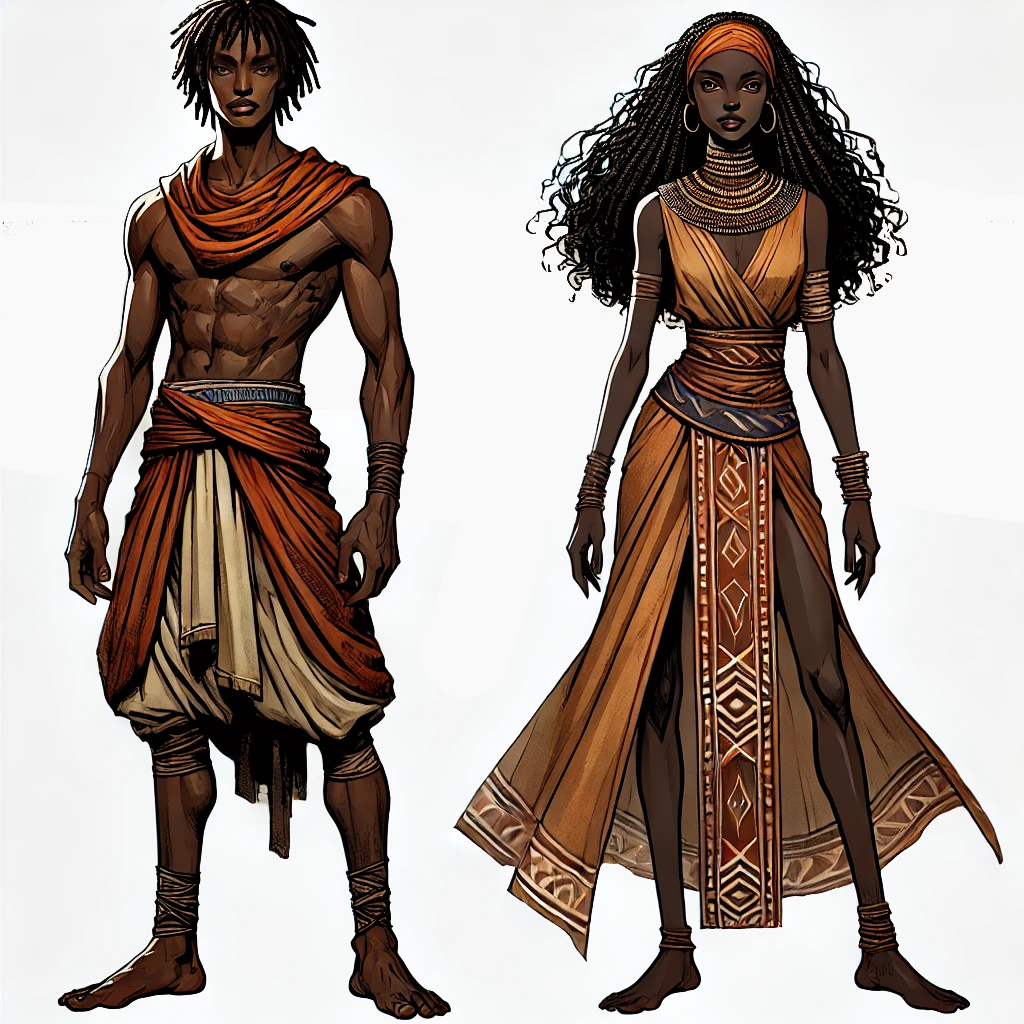
The Nenadans are a nomadic but united people dwelling in the parts of the south-eastern deserts and badlands that cannot support urban centers and hence are relatively free from the ‘civilizing’ touch of the Caliphate. Still, the Nenadan existence is gruelling, many being taken into slavery or forced to turn to depraved acts of survival in the wastes of the world. Their culture is known to be one of the oldest, said to have existed even before the last shift and the formation of Kaelera. Perhaps this is why the Nenadans have a reputation of remaining sure of themselves even in the worst conditions. The few Obrulion scholars who have studied the Nenadan people speculate that there is something deeper at play behind their inhumanly calm visage, a long kept secret that gives them this confidence. Any who have ever encountered a Nenadan will corroborate the story that there is just something…off about them.
The Nenadan people are tall-statured (men averaging 5’10”) with slender to athletic body builds, characterized by broad shoulders, narrow hips, and long legs. They have roundor diamond-shaped faces with narrow, steep foreheads, wide cheekbones, round chins, wide mouths, and full lips. Nenadan eyes are large, round, and black. Their glossy skin ranges from coffee-colored to brown-black. Their hair is black and tightly curled. The men have little to no beard and body hair.
Nenadans are usually named in Old Nenadan after a totemic animal, a desired personality trait, or a tribal hero. The Nenadans do not carry hereditary surnames. Chiefs, heroes, and shamans may take or be given a sobriquet after their given name (e.g. if Masamba has outfought a lion, he might be “Masamba the Lion-Hearted”).
Male Names: Abimbola, Babtunde, Chiumbo, Isingoma, Jengo, Kwame, Masamba, Olabode, Simba, Tifari
Female Names: Ameena, Binta, Denisha, Habika, Kabira, Mandisa, Nakeisha, Rafiya, Safara, Zabia
Dwarven
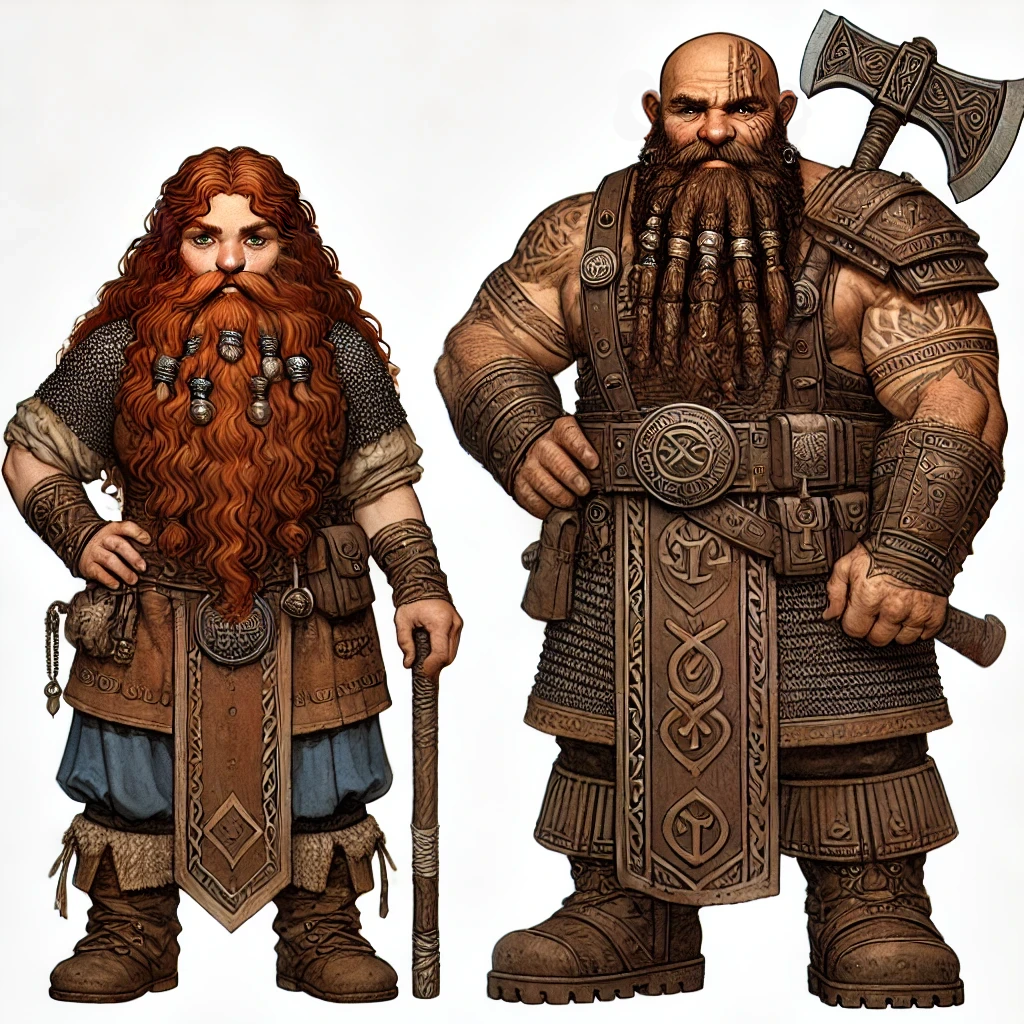
For as long as any man remembers, the stout and cunning dwarven people have delved vast vaults in the Gartnait Alps, gathering rich ores and creating enduring works of stone and iron. The occasional dwarven vault was delved in other mountain ranges too as the people expanded. Today, the dwarves are an embattled race, fighting a never-ending war against the fast-breeding beastmen that have invaded their tunnels. Dwindling in number, barely clinging to their last ancestral holding, dwarves are rarely seen by mankind. Those that do mingle with humans are almost always adventurers or refugees of some sort.
Dwarves are very short-statured (men averaging 4’) but exceptionally stout, weighing as much as adult humans, with broad shoulders and hips, thick-boned limbs, and sturdy digits. They have large, round heads with prominent brows and strong chins. Their eyes are large, round, and very deep set, colored either grey, grey-brown, green, hazel, or light brown. Their skin ranges from medium to very dark brown, ocher, or sienna. Their hair is wavy or curly, and colored chestnut, grey, or black. Both the men and women have heavy beard and body hair.
The Dwarves are usually named in Old Dwarven for a close relative, famous ancestor, or vault hero. In addition to their given name, all dwarves carry a hereditary family name. Each dwarven vault will have a small number of surnames associated with the families of that vault. The vault itself is always named after its founder’s family. A vault founder’s surname carries great prestige among dwarves (e.g. a dwarf named Hurgon Radokh who hails from the vault of Azen Radokh is likely a person of some importance). In addition to their given name and surname, dwarves enjoy collecting sobriquets and nicknames; any dwarf of distinction will carry at least one and sometimes two or three.
Male Names: Arsic, Bombor, Denor, Hurgon, Korten, Morto, Norden, Stahlur, Torrad, Wharto
Female Names: Arsi, Balla, Dara, Efti, Fili, Klia, Lara, Mora, Shylda, Thora
Surnames: Breth, Domekh, Forkus, Gede, Karodar, Makor, Oengus, Radokh, Talorgen, Uoret
Elven
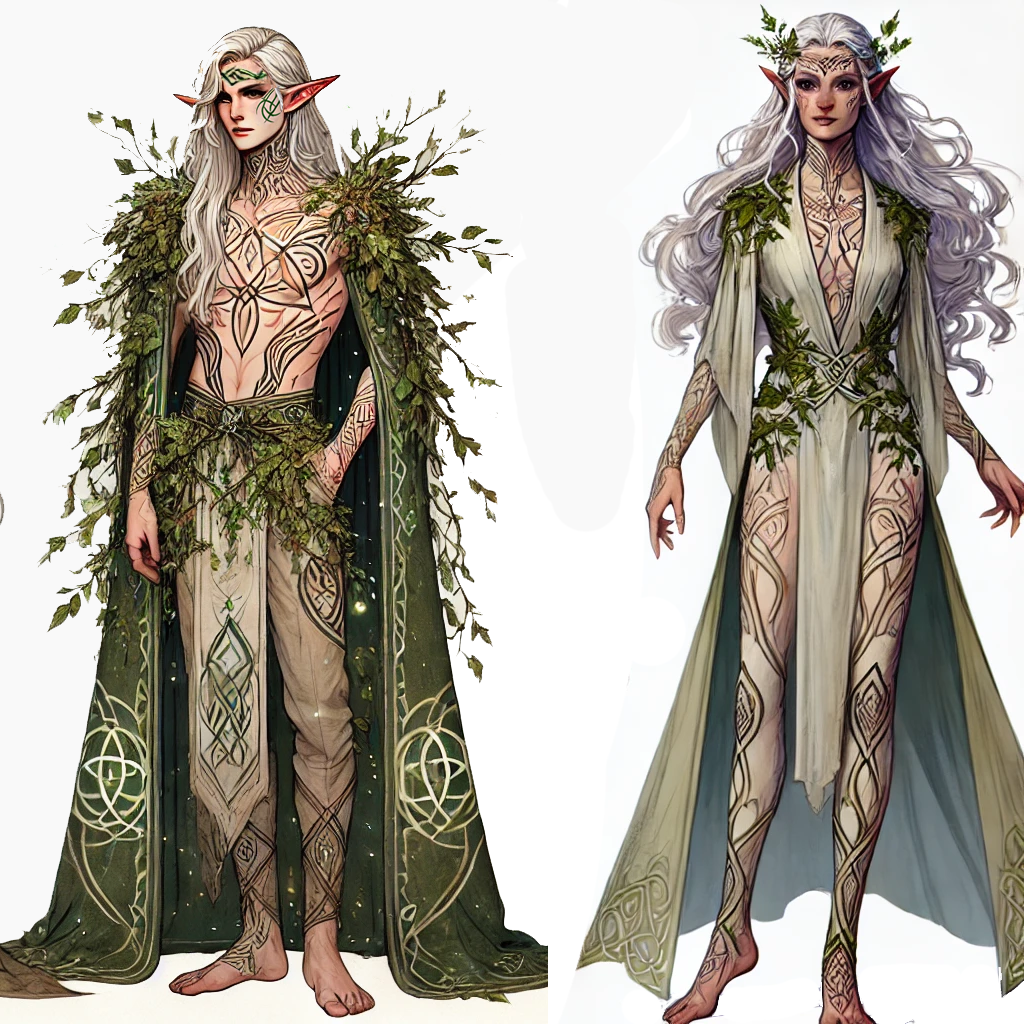
Elven civilization was at an advanced state well before human civilization appeared. The Elves claim they have always existed and talk of The Night of Eternal Darkness, a great cataclysm that rent the world, causing the first shift and the appearance of all other peoples. Today only a single elven kingdom survives on Kaelera in the northern jungles, though scattered fastnesses can still be found in forests throughout the continent. Elves hailing from the jungles style themselves “high elves” and count themselves as the inheritors of their race’s ancient glories. Elves from the outlying fastnesses are generally called “wood elves.” What they lack in arrogance, wood elves more than make up for in reclusiveness, a trait already prominent in the high elves. Elves are so rare throughout human realms that the appearance of one is usually taken as some kind of omen. They are viewed with either suspicion or awe and tend to find it hard to avoid trouble and attention. Adventuring tends to suit a life of being on the run and getting involved in world shaking matters quite well.
Elves are short-statured (men averaging 5’6” in height), but have such lithe, well-proportioned bodies that all other races look ungainly in comparison. They have long heads and heartshaped faces with high cheekbones, finely-chiseled features, and full lips. Their eyes are almond-shaped and colored grey, blue, violet, green, or amber. Their hair is straight or wavy, and colored platinum, gold, silver, or blue-black. Their eyebrows are slender and they have neither beard nor body hair growth. Elven skin is pale, almost pure white, but suffers neither burning, browning, nor wrinkling — the elves look ever young and fair to the eyes of men. Despite this lack of natural blemishing, tattooing of the body and face is common among elven society, seen as much as an art form as a practical way to distinguish age, status or other achievements and associations.
Elves are always given names in the lilting Classical Elven language. Elven men are traditionally named for their paternal relatives, elven women for their maternal ones. Most Elves do not use family names. Their men indicate lineage with the patronymic Mag (“son of ”) followed by the father’s name (e.g. Aodan, son of Seanan, would be “Aodan Mag Seanan”). Their women use the matronymic Ni (“daughter of ”) followed by the mother’s name (e.g. Irial, daughter of Saorla, would be “Irial Ni Saorla”). The identifiers Mag and Ni are sometimes dropped. Elves descended from a famous noble or hero may append the identifier Ua/Ui (“descendant of ”) followed by the name of their ancestor (e.g. if Aodan is descended from the great hero Orthanach, he may call himself “Aodan Ua Orthanach”). This practice is most common among the high elven families of the norhtern jungles. Ever-suspicious of outsiders, elves who leave their fastnesses often conceal their lineage and instead use sobriquets in the local tongue (e.g. Aodan might call himself “Aodan Silverhair”).
Male Names: Aodan, Brogan, Caoimhin, Eadan, Fionntan, Mainchin, Orthanach, Rigan, Seanan, Tomman
Female Names: Arial, Ceara, Dairinn, Enya, Irial, Mornya, Niamh, Riona, Saorla, Una